
Monday, July 12, 2010
Color Theory for Thread: Basic Shading for Embroidered Appliqué
 9:26 AM |
  Posted by
Ellen Anne Eddy |
Posted by
Ellen Anne Eddy |


Now, don't be silly. We know the answer to the age old question, "How many mushrooms do you put in a quiche?" The answer, of course, is" How many mushrooms do you have?"
But it's not exactly that reason. You don't pull in a million colors because you could. You do because it's how nature is. It's all about variance.

.jpg)
To weight the embroidery, I'll add a shader at the bottom of each area. A shader can be a darker complement to the color or dark blue, grey, brown, green or purple.
To lift the color and make it more exciting, we'll add a shocker right before the last color. It can be a bright complement to the basic color or orange, lime, hot pink, or bright purple.

Wrapping it up:

- Pick a wide range of colors from dark to light for each zone. Go way lighter than you intend for highlights and way darker than you might to weight the piece.
- Pick a complement or very dark color to shade your piece.
- Pick a complement or very bright color to shock your shades.
- End with the color you want to see the most. You will.

Color Theory for Thread: Basic Shading for Embroidered Appliqué
Now, don't be silly. We know the answer to the age old question, "How many mushrooms do you put in a quiche?" The answer, of course, is" How many mushrooms do you have?"
But it's not exactly that reason. You don't pull in a million colors because you could. You do because it's how nature is. It's all about variance.
To weight the embroidery, I'll add a shader at the bottom of each area. A shader can be a darker complement to the color or dark blue, grey, brown, green or purple.
To lift the color and make it more exciting, we'll add a shocker right before the last color. It can be a bright complement to the basic color or orange, lime, hot pink, or bright purple.
Wrapping it up:
- Pick a wide range of colors from dark to light for each zone. Go way lighter than you intend for highlights and way darker than you might to weight the piece.
- Pick a complement or very dark color to shade your piece.
- Pick a complement or very bright color to shock your shades.
- End with the color you want to see the most. You will.
Friday, July 2, 2010
Musings:Art Outside the Box: Fantasy Land vs The Real Thing

"Wouldn't it be rather a pull sometimes to have--a--to haven?" He hung fire; he wanted me to help him by phrasing what he meant. But I couldn't--I didn't know. So he brought it out awkwardly: "The REAL thing;"....
She was always a lady certainly, and into the bargain was always the same lady. She was the real thing, but always the same thing.
Henry James, The Real Thing
I often find myself caught on the accuracy issue. If your work is based in some kind of reality, you really do need to figure out how much reality you want in it. Some of this is constitutional. Some of it is artist's license. Most of it is a statement louder than words.
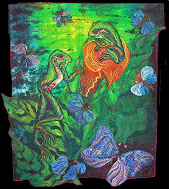
Realism is always impressive. It bespeaks of excellent drawing skills and a keen eye. It's more impressive when we see it outside the standard art forms. It's great to draw a frog in pencil, or charcoal or paint. It's a whole other thing to do it in thread.It's also worth saying there really are blue frogs.


And there are those moments when reality simply isn't as much fun.

Well, by the time you've put wings on it, reality has pretty much flown out the window. But the fun hasn't.
Don't be caught by the trap of reality. Like fire, it's a good servant and a poor master. Use it while it serves you and leave it whenever it just doesn't have enough luster to lighten things up.
You'll find A Noble Steed in Patti's book on Amazon.com. Her web page is at PMC Designs.
Monday, June 28, 2010
Basting: It's Not Just for Turkeys

 Several weeks ago, I went looking to order another basting gun. They don't last forever. Even with new needles, there's a day when the pin bends. I was appalled to be told my supplier wasn't carrying them anymore.
 These are a love/hate item for a lot of quilters. Do they leave holes? Yep. They can. Do they jam? Yep, they do.Why am I insistent on having one? Because they're still the most hand-friendly way to baste out there.

In comes my tack gun.I can tack things up, look them over, clip out whatever doesn't work. Problems and all, I'm still in love.

The Quilt Basting Gun
 is a good design tacker. It's perfect for basting large elements to your quilt.
  You might want to consider the Micro stitch
 for basting quilts. The tacks are smaller and leave smaller holes. I usually steam a quilt and the holes all pull together.
Either way, I feel the baby is in danger of going out with the bath water here. They're not a perfect tool, but I can't imagine being without.
Basting: It's Not Just for Turkeys
Several weeks ago, I went looking to order another basting gun. They don't last forever. Even with new needles, there's a day when the pin bends. I was appalled to be told my supplier wasn't carrying them anymore. These are a love/hate item for a lot of quilters. Do they leave holes? Yep. They can. Do they jam? Yep, they do.Why am I insistent on having one? Because they're still the most hand-friendly way to baste out there.
In comes my tack gun.I can tack things up, look them over, clip out whatever doesn't work. Problems and all, I'm still in love.
The Quilt Basting Gun
is a good design tacker. It's perfect for basting large elements to your quilt. You might want to consider the Micro stitch for basting quilts. The tacks are smaller and leave smaller holes. I usually steam a quilt and the holes all pull together.Either way, I feel the baby is in danger of going out with the bath water here. They're not a perfect tool, but I can't imagine being without.
Thursday, June 24, 2010
Musings: Art outside the Box:History, Herstory

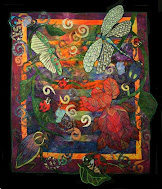
Dancing in the Light
Ellen Anne Eddy
My quilt, Dancing in the Light, is being acquired by the National Quilt Museum in Paducah, KY. I'm still looking behind me to see if there's another Ellen Anne Eddy somewhere they were talking to, and how I might have gotten confused.Words fail me.
It's not the first time I've had a quilt in a museum. It's not even the first quilt I've had in a permanent collection in a museum. But it's the National Quilt Museum and it's an honor past comprehension. It's a bit like being put in the Rock Music Hall of Fame, or in the Baseball Hall of Fame.
Why?

Almost all of the innovations come from the margins. We tend to forget that. When you see Degas and Monet on coffee cups and umbrellas, you could forget how very marginal they were. You could forget that they weren't allowed show their art with other legitimate artists. They were mocked and scorned. And yet what came out of their art was the beginning of modernism. They created work the world had never seen before. Somehow, someone fell in love, bought and protected those odd paintings. Someone put their collections into museums. We would not know them now if that hadn't happened. Many Van Goghs were cut up to make shoes. But not the one's his brother Theo saved. Art is dependent on preservation.
The Art Quilt movement, to my knowledge, is unique. But it too is marginal. It began as a grass roots movement of women who simply wanted to express themselves in fabrics and quilts. And not just any women. These were almost all women past their menopause. The captions on art quilt shows have read" Not your grandmother's quilts" long enough that actually they could be your grandmother's quilts. But it's been a place where women have had their say.Not just your models and your actresses. Not just beautiful women. Not wives of powerful men. Women who've hit the strength and power of their middle lives.Women who's children have grown and gone and who have worlds of things to say. And who have found a million ways to say it in their art.
How rare is that in history? The women artists lionized in art history books are almost all exceptions. They were brave enough to play with the boys club. They were many of them marginalized out of existence only to be rediscovered in history waves of reminiscence.
I don't think I'm being melodramatic when I say that history has often forgotten her story. For every historic woman, you'll see a list of ten men. We often see their histories written as historic romance, since we don't know for sure, and that's what women do, right? I can't help but wonder how much of that is male wishful thinking. Or our own.

They tell me my quilt will probably be shown with a group of 20 quilts they've acquired to celebrate 20 years of their existence, sometime next year. You'll find it at The National Quilt Museum
215 Jefferson Street
Paducah, KY 42001-0714
(270) 442-8856
Wednesday, May 26, 2010
Musings: Art out of the Box: The Mentor Waltz

I was an unlikely candidate. My high school years were a cycle that ran between hide and seek and Lord of the Flies. Ugly things happened at dance class. I'm pretty good at taking a pratt fall, but I missed the humor. I'd learned to never go near a dance. Some humiliations are enough.
But Donna and Roy were relentless. Kind, but relentless. Not only would I play waltzes and reels, I would dance. Donna would take away my guitar I was hiding behind and Roy would take my hand, keep me safe, and sweep me into the movement and the music.
For those of you who have never done contra, it's the antithesis of couple dancing. It's really a lovely version of ring-around-the-rosie for adults. And everyone is included. Couples dance with everyone, sometimes holding their babes. Everyone is part of it.
But there is a skill set. You need to know which is your right hand. It really does help.
Now, what do they do if you don't know which is which? Someone kindly grabs your right hand and says"The other right hand." I love contra dancers.
Time passed and I finally began to learn. Before my knees gave out, I could stand on a floor, swing, hand out my hand, and find myself beaming like a pumpkin. It's genuinely fun.
It strikes me that this is exactly like mentoring. It's not a formal thing usually. It's just someone in front of you, a little unsure, a bit confused.The answers are simple enough. It's just like contra dancing. You grab the right right hand and give them gentle push in the right direction.


Over the years I've passed it on as best I could. I've mentored people, mostly not in a formal sense. Just in the sense that you grabbed the right right hand and put them on their way. Classroom is built for it. The end of class is never the end of anything. I hear from students years after as they go on to create amazing things. Often I see them later across from me at a teacher's table in a conference. I'm always proud for them.
But independent studio time is a more intense way to set up that. People come to my studio when they want, stay with me, sew as long as they want on what they want. And we focus on the direction they want to take. Lately I've had the privilege of having Genny Frazer from Australia. Her energy,sense of fun, and enthusiasm was contagious.

If you'd like to come to my studio for independent studies, contact Melida to schedule it.
So I hope you get the chance to do both. To be a mente and and mentor. To grab the right right hand, to have gentle direction when needed, and to pass it on in the same gracious light. Come and join the dance!

Subscribe to:
Posts (Atom)
Review of Thread Magic Garden

From the Subversive Stitch
Review of Thread Magic Garden

Book Review from Golden Dog Quilting
C&T Blog

My Studio Garden: A blog at C&T Publishing
Like us on Facebook

Quiltposium, Fall2011

Ellen's New Article, Dance of Design
Essential Embroidery Stitches: Free Hand and Machine Embroidery Designs and Techniques.

Get this free book from Quilting Arts. It has a series of articles I wrote called Defining the Line.
The Butterfly Effect

My Blog List
-
3 weeks ago
-
2 months ago
-
4 months ago
-
7 months ago
-
1 year ago
-
2 years ago
-
5 years ago
-
6 years ago
-
6 years ago
-
7 years ago
-
7 years ago
-
9 years ago
-
9 years ago
-
9 years ago
-
10 years ago
-
10 years ago
-
10 years ago
-
10 years ago
-
11 years ago
-
11 years ago
-
12 years ago
-
12 years ago
-
12 years ago
-
12 years ago
-
12 years ago
-
13 years ago
-
13 years ago
-
13 years ago
-
13 years ago
-
13 years ago
-
13 years ago
-
14 years ago
-
14 years ago
-
14 years ago
-
14 years ago
-
-
-


Guest Blog On Subversive Stitchers!
The Stories Tell Me

Facebook Badge

Guest Blog On Quilt Gallery
http://quiltinggallery.com/2010/08/12/dancing-in-the-light/
